
Our operations
Building, operating and maintaining one of Australia’s largest electricity distribution networks requires a significant operational program to monitor the health of network assets, undertake preventative maintenance and respond to faults and emergencies.
2023-24 Highlights
-
16.9%average reduction in public lighting customer bills
for 2024-25 - $10Minvested in research and development
- 965,000asset inspection photos taken
- 10,000poles replaced
Network maintenance
Maintenance is critical to the continued reliability, resilience and safety of the network. During 2023–24, we completed more than 150,000 maintenance tasks. The network maintenance backlog remained below 2,500 tasks throughout the year, with 2,031 tasks in the backlog at 30 June 2024.
This followed the successful Big Hits program, which in 2022–23 reduced the number of backlog tasks from more than 11,000 to fewer than 2,400, with the peak created by numerous extreme weather events over the previous years.
A busy storm season between October 2023 and March 2024 contributed to a total of 27,935 unplanned outages during the year.
This included two major event days, on 4 October and 25 December, with more than 200 field employees working to restore customer supply on Christmas Day.
2023-24 Network highlights
Asset inspection
- 304,600power pole inspectionsup from 297,129 last year
- 38,187kmof powerlines inspected via drone inspectionsup from 32,251km last year
- 77,190drone flights by asset inspectorsup from 67,830 last year
- 965,643inspection photos takenup from 830,429 last year
Maintenance, capital improvement and fault and emergency
- 19,712planned outagesup from 18,397 last year
- 27,935unplanned outagesup from 24,657 last year
- 14,346cross arm replacementsdown from 15,392 last year
- 10,452pole replacementsup from 7,638 last year
- 8,940zone substation preventative maintenance work tasksup from 8,257 last year
- 9,858service mains overhead replacements (contractors)up from 2,047 last year
- 1,014construction milestonesup from 994 last year
Fleet
- 420,783pre-operational fleet inspectionsup from 384,615 last year
- 36,516,918kmtravelledup from 34,365,107km last year
Meter reading
- 98%of meter reads to schedule up from 96% last year
Vegetation management
- 194,788powerline bays with vegetation treated up from 186,981 last year
- 14,767fall-in risk trees (hazard trees) removed down from 20,295 last year
Major projects
One major project with total direct project costs exceeding $1.5 million was completed during 2023–24. The $1.5 million threshold for major projects aligns with internal reporting for network investment.
In January 2021, contractors working on behalf of Kosciuszko National Park damaged both 11kV cables supplying Charlotte Pass village, leading to subsequent failures. Extensive water ingress and damage to one of the cables necessitated its full replacement. The cable supplies critical power to Charlotte Pass ski resort, which faces extreme weather conditions and access limitations across the winter period. The project to replace the end-of-life High Voltage 11kV underground cable supplying Charlotte Pass ski resort was completed in late April 2024. It was delivered to budget, time and quality.
| DESCRIPTION | BEFORE 2023-24 (DIRECT PROJECT $) | 2023-24 (DIRECT PROJECT $) | TOTAL COST (DIRECT PROJECT $) | COMPLETION DATE |
|---|---|---|---|---|
| Jindabyne Charlottes Pass High Voltage cable replacement | $1,822,908 | $4,941,733 | $6,771,641 | 29/04/2024 |
Vegetation management
Essential Energy trims or removes trees and other vegetation that could impact powerlines and start a bushfire, cause a power outage or cause an electrical safety risk. During 2023–24, Essential Energy and its contracted service providers treated 194,788 bays containing vegetation and removed 14,767 fall-in risk trees (hazard trees).
The Essential Energy vegetation management team actively participate in national and international forums, sharing knowledge and seeking to continuously improve practices. In a recent survey of electricity utilities across Australia, North America and Europe, Essential Energy benchmarked favourably for the efficiency and effectiveness of its vegetation management program.
Engagement with local government councils continues to be strengthened, with five new memorandums of understanding (MOU) put in place during the year, with Carrathool, Greater Hume, Leeton, Tweed and Temora shire councils. Essential Energy now has 14 vegetation management MOUs in place across its network, helping to ensure mutual benefit and positive outcomes in regional communities.
Bushfire preparation
Powerlines can be a source of fire ignition, a risk that is elevated on high fire risk days. We invest significant effort and resources in reducing ignition risk as far as practicable.
We undertake formal fire risk safety assessments and identify treatment controls to reduce ignition risk and apply sophisticated risk modelling to understand the impact of investments, climate change and fire behaviour in the landscape, under different weather scenarios.
We engage independent bushfire preparedness audits or reviews to ensure our safety regulation obligations, managed by the NSW Independent Pricing and Regulatory Tribunal (IPART), are met. The 2023–24 IPART audit found that Essential Energy was largely in accordance with Australian Standard 5577 for Electricity Network Safety Management Systems (ENSMS). An ‘in-field’ audit regime was conducted, covering 346km of powerlines, with 619 observations made. Twenty-five observations from 20 sites constituted a non-compliance with the implementation of the Essential Energy ENSMS. These have been addressed, including putting measures in place to better manage and monitor vegetation management practices. Also, further enhancements to practices are being adopted to more effectively manage implementation of the ENSMS.
Our fire risk management approach is overseen by senior management through our Bushfire Risk Assurance Panel.
Routine powerline and vegetation inspections, pre-summer bushfire inspections of high-risk areas, and specialised inspections of critical assets, underground equipment, substations and sub-transmission lines contribute to our risk management approach. Asset maintenance, repair and renewals also help to manage this risk. Our significant investment in vegetation management keeps powerline corridors and easements clear across our network.
Adjusting how we operate the network on high fire risk days further supports bushfire preparation, such as disabling the automated re-energising of powerlines after a fault and applying more sensitive protection settings.
Our network planning, design and construction is further addressing ignition risk, with insulated materials, pole-top designs that maximise conductor clearances, underground solutions for fire-prone areas, and protection system upgrades helping to reduce fault current levels and meeting modern network standards. Research and development of innovative early fault detection, sparkless fuses, cabling and SAPS technologies, amongst others, has the potential to further reduce this risk.
Modelling completed by the University of Melbourne has significantly enhanced our understanding of network-initiated fire risk across our network area. As a result, we have revised our bushfire priority zones and commenced transitioning asset inspection, asset maintenance and vegetation management activities to align with this. To date, we have reprioritised our pre-summer aerial bushfire inspection and asset maintenance scheduling, and trialled new priorities for three Vegetation Management Areas. Outcomes will help us mitigate network-initiated fire risk and manage asset resilience in line with updated bushfire risk levels.
We are engaging with industry network operators, fire risk researchers and experts to share insights and enhance our understanding of risks and risk treatment options. During 2023–34 we initiated a joint power and telecommunications industry forum with state government agencies, given the critical nature of these services to communities. We also participate in the International Wildfire Risk Management Consortium, and work closely with the NSW Rural Fire Service, with representatives on district Bushfire Management Committees and participating in annual multi-agency briefings and seasonal outlook reviews.
Public lighting
Essential Energy is responsible for the management, maintenance and/or billing of approximately 176,000 public lighting assets for 104 customers including local government councils. Essential Energy owns approximately 168,000 of these assets, 98 per cent of which use energy-efficient LED lights.
As part of our 2024–29 Regulatory Proposal, we consulted with public lighting customers throughout the year to inform pricing for the 2025–29 period. The Australian Energy Regulator (AER) Determination resulted in an average real reduction in customer bills for public lighting of 16.9 per cent for 2024–25 (in 2024–25 dollars).
Throughout 2023–24, we supported local government councils with the installation of public lighting, improving public safety through 10 minor capital projects.
Our Bathurst smart streetlighting pilot concluded in June 2024, having explored the benefits and issues of this technology for the council and Essential Energy. See Public lighting for details.
Remote area internet access
It is important that our field crews have reliable internet access when working in remote areas, for their safety and access to digital business tools. During 2023–24, we trialled a low Earth orbit satellite internet service in remote locations with telecommunication ‘black spots’. Sixty-eight Starlink devices were provided to crews across NSW and evaluated while completing field operations, emergency response and remedial work tasks.
The pilot provided reliable and continuous internet access with good data transfer times in locations with known connectivity challenges. Starlink was effective in critical operations and emergency situations, working well at fixed locations and while field crews were on the move.
The pilot increased both field crew safety and communications efficiency. Its success emphasises the importance of high-speed remote location connectivity solutions for our business. These outcomes are informing our field communication strategy, with plans to explore a business-wide solution in the coming period.
Research and development
Essential Energy invested $10.3 million in research and development1 activities during 2023–24, to enable the energy transition, develop the network of the future, and improve public lighting.
Enabling the energy transition
We continued investing in technologies and innovations necessary to enable the energy transition, including:
- trialling pole-mounted electric vehicle (EV) chargers and developing a prototype integrated streetlight EV charger with partners (see Pillar 3: Facilitate electric vehicle adoption for details)
- completing groundwork for a longitudinal study of fast EV charging impacts on network infrastructure, with the objective of releasing more network capacity for fast EV charging, in partnership with the University of NSW (UNSW) and RACE 2030. This is likely to have national implications.
- creating a purpose-built innovation test facility, to mimic a residential house of the future, to develop our capability and underlying systems for the future energy ecosystem (see Case study: NEXUS innovation test facility for details)
- beginning a Vehicle to Grid (V2G) study with CSIRO, at NEXUS, that will inform both Essential Energy and industry approaches to V2G integration
- co-developing a prototype lower noise ground-mounted battery with an Australian battery supplier, to be tested at NEXUS
- commencing an ‘early fault detection’ technology trial for bushfire risk reduction and inverter-led system fault detection
- continuing our Smart Energy Communities trial (see Pillar 4: Enable smart communities and new customer solutions for details).
Future networks
Our future networks research and development activities focus on developing capabilities needed to modernise the electricity grid as the energy landscape changes, while maintaining agility to respond as new developments emerge.
Activities to support dynamic customer connections during 2023–24 included:
- developing capability to enable customers to flexibly access network capacity, particularly maximising customer rooftop solar exports
- developing and deploying a foundational customer energy management system (CERM), to enable dynamic connections and future CERM capability development
- developing new tariff options that can flexibly operate to minimise costs for customers and impacts to the network, including Sun Soaker tariff for residential customers with CER, and dedicated tariffs for small and large grid-scale batteries.
We have continued to focus on alternative energy supply, evaluating and developing alternative load and generation technologies to present more cost-effective ways of managing network and customer needs than traditional network solutions. These include:
- trialling a Hydrogen-based SAPS as a sustainable alternative energy supply solution (see Stand Alone Power Systems)
- researching the viability of storage-based microgrids on rural high voltage network segments to improve network reliability and resilience
- trialling a 1MW/2MWh network battery at Sovereign Hills, near Port Macquarie, as a means to strengthen network reliability
- developing and evaluating new ways to analyse network data, including proactive network fault identification processes using network performance analytics data
- trialling emerging voltage management technologies, such as alternative load control settings to use excess generation from solar panels, and on-load tap changer voltage regulation technology
- building capability and tools to better understand available network capacity for load and generation and to forecast network constraints in different scenarios.
Public lighting
We concluded our smart streetlighting pilot with Bathurst Regional Council in June 2024. It involved placing 110 light point controller smart nodes across the local government area to control lighting output and receive fault and light information. The trial was extended by six months to allow for additional benefit analysis, with dimming and trimming features trialled in preparation for National Electricity Rule changes coming into effect to permit smart node metering of public lighting. Trial outcomes will be shared with involved stakeholders by October 2024.
Case study
NEXUS innovation test facility
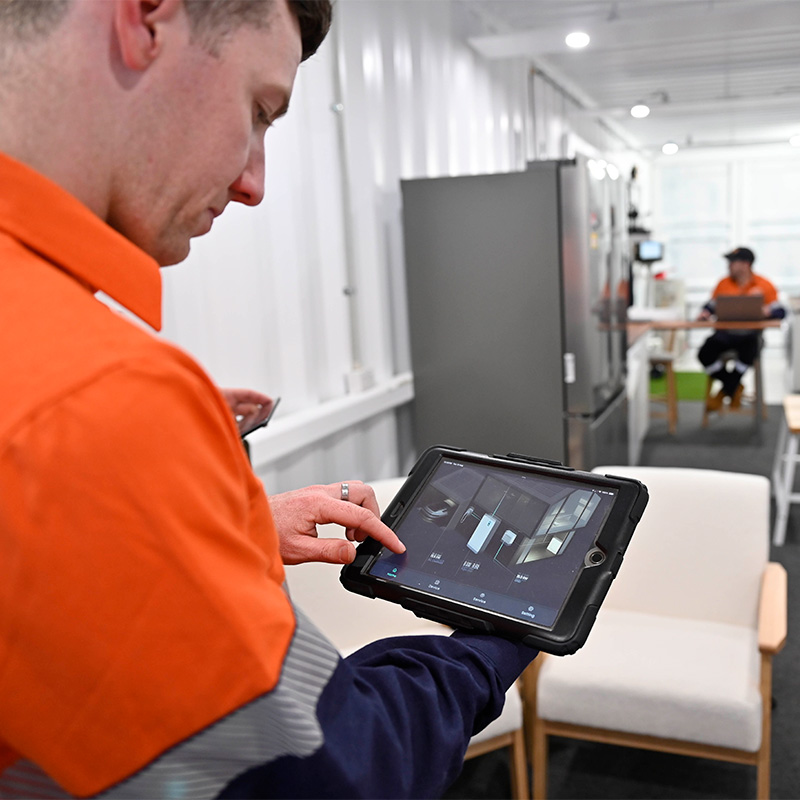
Testing is an important input into our understanding of energy innovations, particularly given the rapid pace of technology development. To explore the integration of Consumer Energy Resources (CER), such as rooftop solar and batteries, into residential homes, we designed and built the New Energy Exploration and Utility System (NEXUS) innovation test facility in Port Macquarie, as an addition to our Quality Assurance Laboratory.
NEXUS mimics a house of the future, with CER integrated with household appliances that have Internet of Things (IoT) capabilities. We are using it to explore the application of IoT capabilities to household energy optimisation. We are also developing our technical capabilities and underlying systems through CER interoperability testing, which is helping us to shape the future renewable energy ecosystem.
Our partners are also benefitting from NEXUS, with the CSIRO Vehicle to Grid (V2G) study and a new ground-mounted battery design currently being tested at the facility.