
Sustainability strategy
The Essential Energy Sustainability Strategy has three pillars, reflecting a holistic approach to sustainability:
- Responding to climate change
- Empowering our people
- Enabling regional development and resilient communities.
We are committed to supporting the transition to a net zero economy while continuing to provide safety and wellbeing initiatives, and championing an inclusive, supportive and growth-oriented culture. We contribute to regional communities through our partnerships, advocacy, engagement and tech-enabled solutions.
Our Sustainability Strategy guides our approach to generating positive value for customers, the communities we serve, our people and the environment.
Our sustainability approach builds on our Corporate Strategy to highlight the sustainability priorities important to our business and our stakeholders and furthers our strong foundation of sustainability-related activities.
Pillar 1: Responding to climate change
Pillar 1 commitments
- Facilitating the net zero transition – by supporting electrification, including electric vehicle (EV) penetration and scaling and optimising network connections
- Building climate resilience and partnering to minimise disruptions during crisis – by future-proofing assets, providing our customers with alternate energy solutions and responding to climate events
- Decarbonising our operations – by electrifying our fleet, leveraging renewables and actively managing distribution network losses in the way we build, operate and maintain the network.
Pillar 1 outcomes delivered in 2023-24
Facilitating the net zero transition
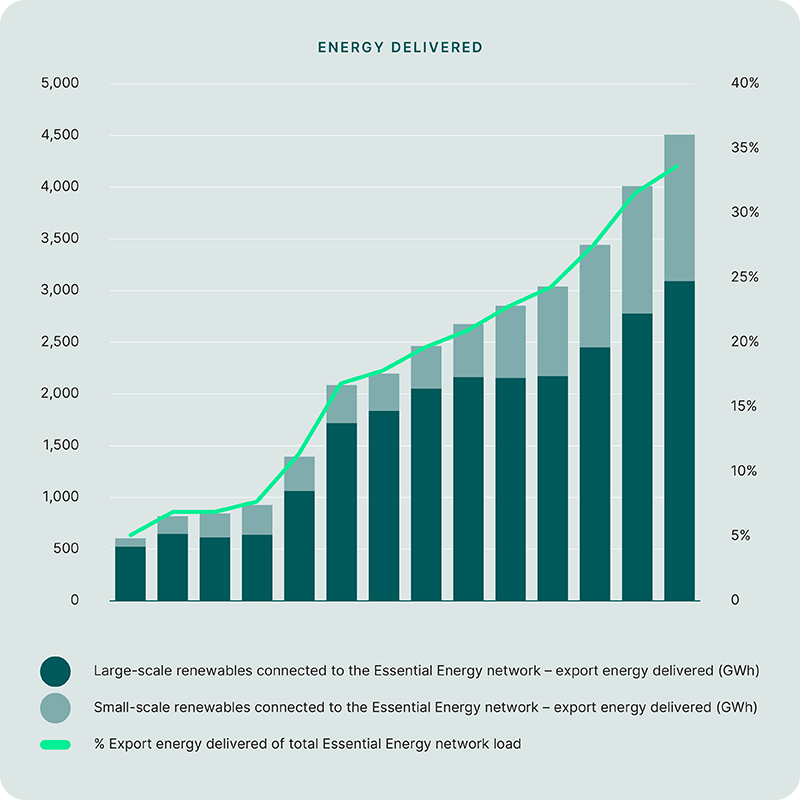
The number of renewable energy generation connections to our network continued to grow during 2023-24. Eleven new large-scale1 facilities were connected, along with more than 34,000 small-scale systems (mostly rooftop solar). Total capacity was 1.54GW for connected large-scale renewables and 2.08GW for small-scale renewables, at 30 June 2024.
Renewables delivered 33.7 per cent of the Essential Energy network load, building on more than a decade of growth (see Figure 2 below).
Figure 2. Growth in export energy delivered to the Essential Energy network from large-scale and small-scale renewables
We continued to facilitate EV charging infrastructure developments across the network this year, including innovative solutions and partnerships with EV charging providers expanding options for EV customers. See Pillar 3: Facilitate electric vehicle adoption for details.
We continued to transition the network from 240V to 230V, improving capacity to allow more customers to export renewable energy into the network while maintaining a safe and stable power supply. For more information see Enabling greater exports and network use.
The introduction of batteries across our network is increasing capacity to capture and store renewable energy locally for release into the network when needed.
During the year, we installed our first two pole-mounted batteries. We plan to deploy 35 pole-mounted community batteries in a trial with Origin Energy, with the first of these installed in Wagga Wagga during June 2024. Additionally, Australian Government grant funding will support the installation of three community batteries on the network, which are expected to be in place by early 2025. See Consumer Energy Resources innovation for details.
We are working to support our customers as they electrify. Our Electrification Strategy encourages and supports customer and government net zero emission targets while strengthening the network to enable greater load and storage for peak demand periods. Find out more in Electrification.
1. Large-scale renewable generation facilities are dedicated to providing electricity into the grid, rather than offsetting onsite electricity consumption. Small-scale systems are mostly rooftop solar.
Building climate resilience and partnering to minimise disruptions during crisis
We are working to minimise bushfire risk and impacts to the network and local communities, investing effort and resources to reduce powerline ignition risk as far as practicable. We undertake formal fire risk safety assessments, engage independent bushfire preparedness audits or reviews, and apply sophisticated risk modelling to understand the impact of investments, climate change and fire behaviour in the landscape under different weather scenarios.
Adjusting how we operate the network on high fire risk days further supports bushfire preparation, such as disabling the automated re-energising of lines after a fault and applying more sensitive protection settings. Routine pre-summer and specialised inspections of high-risk areas and critical assets contribute to our risk management approach.
Our network planning, design and construction is further addressing ignition risk, including insulated materials, underground solutions for fire-prone areas, and protection system upgrades. See Bushfire preparation for further details.
We are upgrading our telecommunications infrastructure to keep communities connected during bushfires and storms.
During the year, we installed more than 30 fire-resistant composite poles in South Durras to improve resilience during bushfire events. See Pillar 4: Enable smart communities and new customer solutions for more details.
We also secured an Australian Government grant from the Telecommunications Disaster Resilience Innovation (TDRI) Program, to procure six emergency response Stand Alone Power Systems (SAPS) and complete enabling works to accept ‘plug-in backup supply’ at a minimum of 12 sites. See Resilience for details.
Our 2024–29 Regulatory Proposal, finalised by the AER in April 2024, incorporates resilience initiatives for our network and communities. This will include new systems to monitor network performance and further enable increasing Consumer Energy Resources (CER), as well as installing composite poles, a portable community hub, portable streetlights and SAPS for use during significant weather and network events. See Resilience for more information.
Decarbonising our operations
We furthered our vehicle electrification, with 55 EVs and 24 hybrid vehicles in our fleet, as of 30 June 2024. We have EV charging infrastructure in 15 depots, with plans for more. See Transitioning our fleet for more details.
We are working to remove sulphur hexafluoride (SF6) from our network. During 2023–24, in an industry first, we installed a SF6-free overhead distribution network switch in collaboration with NOJA Power. The switch is a world-first design, with the ability to replace an end-of-life SF6 switch on an existing pole. It has both manual and remote operation options and could potentially replace the approximately 11,400 SF6 switches on our network at their end of life. Our role as an early adopter of this technology provides cost benefits to Essential Energy and the opportunity to partner with NOJA Power as the switch is refined and enhanced.
Essential Energy’s greenhouse gas emissions information are in Tables 17 to 19 in Climate-related Financial Disclosure.
GROWTH IN RENEWABLES CONNECTIONS OVER THE PAST YEAR
Large-scale renewable connections (as at 30 June 2024)
- 57total connections11 new connections in 2023-24
- 1.54GWtotal capacity13.7% increase since 2022-23
- 3,089GWhdelivered11.3% increase since 2022-23
- 23.1%energy delivered of total Essential Energy network load1.2% higher than 2022-23
Small-scale renewable connections (as at 30 June 2023)
- 292,641total connections13.5% increase since 2022-23
- 32.6%of total customers3.6% increase since 2022-23
- 2.08GWtotal capacity33.5% increase since 2022-23
- 1,416GWhdelivered15.1% increase since 2022-23
- 10.6%energy delivered of total Essential Energy network load0.9% higher than 2022-23
Pillar 2: Empowering our people
Pillar 2 commitments
- Ensuring the safety and wellbeing of employees – through our health and wellbeing program and leading health and safety standards
- Championing an inclusive, supportive and growth-oriented culture – by promoting our values and building a diverse and accountable workplace.
Pillar 2 outcomes delivered in 2023-24
Ensuring the safety and wellbeing of employees
Our 2023–24 safety performance was mixed. No Major Lost Time Injuries (LTIs) were recorded, however Serious Claim Frequency Rate (SCFR), Total Recordable Injury Frequency Rate (TRIFR), and High Potential Incidents Frequency Rate (HPIFR) all increased compared with the previous year. Near miss incident reporting also increased slightly. See Safety performance, and Company Scorecard for details.
We expanded our IGNITE wellbeing program, with health checks, health screening and Mental Health First Aid training introduced to support employees in managing and improving their health. We continued to promote public safety so that everyone can live and work safely around our electricity network. See Health and safety and Public safety for details.
Championing an inclusive, supportive and growth-oriented culture
We are continuing to build an inclusive and diverse workforce reflective of the communities we serve.
In early 2024, we launched our 2024–27 Inclusion and Diversity Strategy. We also developed our first Accessibility and Inclusion Plan, created a Working Parents Guide, and delivered domestic and family violence information sessions for more than 1,200 employees.
Essential Energy received the ‘Pay equity’ and ‘Mining, resources and energy’ awards at the Work180 Equitable Workplace Awards 2024.
We continued to participate in the Champions of Change Coalition, demonstrating our commitment to improving female representation in our workforce.
See Inclusion and diversity for details.
We advanced our progress towards reconciliation while preparing our next RAP, through career and business opportunities, cultural awareness, and engagement with Aboriginal and Torres Strait Islander people. See Reconciliation for more information.
We continued to build capability in managing the impacts of the energy transition on our network during 2023–24, with employees engaging with our new future skills training program. More than 1,600 employees completed leadership development programs in 2023-24, with leaders of all levels enhancing their skills as part of our continued focus on building a sustainable pipeline of future leaders.
We welcomed 143 new apprentices, 20 trainees and 21 graduates to Essential Energy in February 2024, bringing the total number of people in Early Talent Pathway roles to 359, at 30 June 2024 – 292 apprentices, 33 trainees and 34 graduates.
See Training and development for details.
Pillar 3: Enabling regional development and resilient communities
Pillar 3 commitments
- Assisting regional business and communities – through partnerships, advocacy, engagement and tech-enabled solutions, to provide reliable and efficient connections
- Ensuring sustainable and resilient supply chains – by responding to social and environmental vulnerabilities in our supply chains and integrating sustainability into our procurement decisions
- Protecting cultural heritage – through engagement with Aboriginal and Torres Strait Islander groups, guardians and landowners and managing risks in culturally significant areas.
Pillar 3 outcomes delivered in 2023-24
Assisting regional business and communities
During 2023–24 we commenced hosting regional Future Energy Roadshows to explore the economic benefits of future-proofing energy with residents and business owners.
In these we shared the positive impact that rooftop solar, regionally-based large-scale renewable generation, and localised and regionally-based energy storage are having on reducing fossil fuel generated power, as well as electricity infrastructure’s role in driving economic benefits for regional communities.
We developed and started using a Customer Segment and Insights Model to help us better understand and serve our customers by grouping them using common characteristics and qualities. This is informing how we research, target and position products and services.
The Smart Energy Communities trial continued, with more than 200 customers using a smart energy management device to monitor energy use and solar generation.
We introduced our first Dynamic Connection Agreement (DCA), which allows us to manage customer inverter settings so they can choose to increase solar exports and generate a better return while improving network’s stability. See Smart Energy Communities for details.
Our telecommunications infrastructure supports our distribution network operations, shares advanced fibre communications with surrounding areas, and supports the renewable energy market. We have more than 1,600 kilometres of fibre across the network, with more than half the capacity available to customers, as well as a vast radio network.
We continued to support community organisations across our network area, donating more than $514,000 to community groups, stakeholders and charity organisations – combined contributions from Essential Energy and our generous employees. See Supporting community organisations for more information.
We continue to work to keep customers’ network charges as low as possible. In real $2023–24 terms, from their peak in 2012–13 of $1,343 per annum, a typical residential customer’s annual distribution network charge reduced to $845 in 2023–24 – a saving of $497 per annum, or 37 per cent. Over the same period, a typical small business customer achieved an annual saving of $2,429, or 41 per cent, with a typical small business customer’s annual distribution network charge reducing from $5,932 in 2012-13 to $3,503 in 2023-24. See Revenue and pricing for more information.
Our overall network availability target is 99.95 per cent. During 2023–24, we achieved 99.96 per cent, so above target and above independently audited reliability requirements.
Ensuring sustainable and resilient supply chains
Since May 2023 we have applied sustainability requirements to sourcing activities worth more than $500,000.
During 2023–24, we procured $6.38 million worth of goods and services from registered Aboriginal and Torres Strait Islander enterprises and partnered with Supply Nation to identify further opportunities.
To be released in December 2024, our 2023–24 Modern Slavery Statement will outline our performance and outcomes, including:
- 95.0 per cent of addressable expenditure was with suppliers who have completed the Modern Slavery Supplier Assurance qualification, successfully meeting our targeted expectations.
- All new suppliers now complete modern slavery assurance during the registration process, as of March 2024.
- Zero human right violations were reported in our supply chain.
We are continuing to meet key suppliers and collaborate with stakeholders to develop relationships and uncover improvement opportunities across the broader industry.
Protecting cultural heritage
During 2023–24 we incorporated the Aboriginal heritage due diligence process into our environmental impact assessment (EIA) documentation. Following Aboriginal heritage awareness training sessions held during the previous year, policies and guidelines were updated to protect and conserve important heritage values.
We engaged an industrial heritage consultant to review restorative works at the former Lismore power station following the major flood event in 2022. The review will include options and recommendations for the future of the power station.