

Essential Energy is surveying the network to collect smarter data for safer communities. The purpose of this surveillance is to create our ‘Digital Twin’, a virtual replica of the network combining data from LiDAR, satellite imagery, geographic information systems (GIS), and asset records to create a 3D model that mirrors the real world.
This is part of our broader digitisation initiative, marking a major step forward in building the electricity network of the future.
Essential Energy is rolling out a Mobile LiDAR Survey (MLS) across selected communities in regional, rural and remote New South Wales. Residents may notice a branded 4WD vehicle driving slowly through their neighbourhoods, specially equipped with a roof-mounted scanner. The vehicle is collecting high-resolution 3D data using Light Detection and Ranging (LiDAR) technology which will be used to create a virtual replica of the Essential Energy network, referred to as a Digital Twin.
The survey vehicle will only operate on public roads and will not enter private properties. It travels at approximately 40km/h and will be clearly marked with Essential Energy branding.
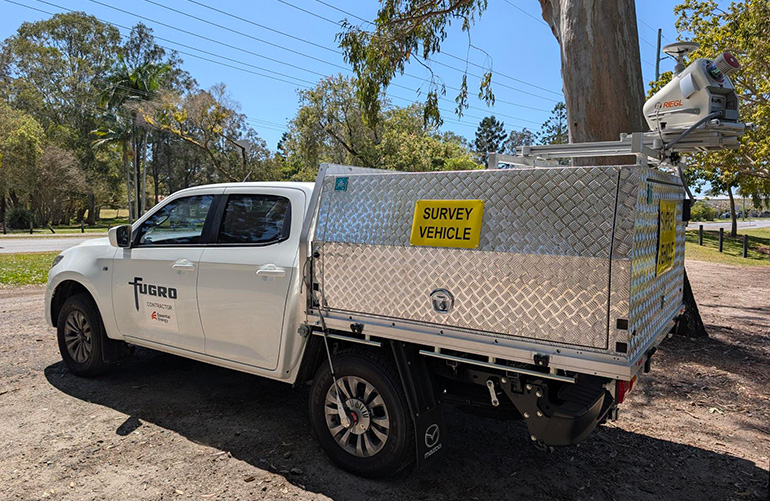
Vehicle fitted with Mobile LiDAR Scanner.
Why is this important for my community?
The data collected through the MLS helps Essential Energy:
- Improve safety and reliability of the electricity network
- Plan upgrades and maintenance more effectively
- Respond faster to emergencies and natural disasters
- Support future energy needs, including renewable energy and electric vehicles.
What is the Digital Twin?
Essential Energy’s Digital Twin is a high precision virtual replica of our electricity network, built using GIS, LiDAR and asset data. It mirrors the physical network’s structure and behaviour, enabling advanced simulations and predictive analysis to support planning, maintenance, and disaster recovery.
The digital twin helps identify network capacity, optimize vegetation management and accelerate renewable energy integration. It’s a powerful tool that improves operational efficiency, reduces costs and delivers better outcomes for customers and communities.


