
11 August 2025
After a very challenging week for residents of the Mid North Coast and New England regions, power has been fully restored to the over 32,000 homes and businesses impacted by the storm that swept through over the weekend of 2-3 August.
All customers on the Mid North Coast had their power turned back on by Thursday morning (7 August), while the complex reconstructions continued until Saturday afternoon (9 August) for those in the New England region.
The increasing frequency and severity of storms continues to cause widespread disruption of homes and businesses and cause extensive damage to the electricity network, highlighting the growing importance of community preparedness and network resilience.
Essential Energy’s network predominantly consists of large spans of overhead powerlines, covering 737,000 square kilometres of regional, rural and remote New South Wales. These spans cross diverse landscapes including desert, coastal areas, alpine regions and dense hinterland. Because of the nature of this expansive network, severe weather events such as storms, bushfires and floods have the potential to cause significant impacts.
Regardless of how electricity is generated, severe storms can disrupt the delivery of power to homes and businesses. During major weather event, poles, crossarms, conductors and wires can all be damaged, often across multiple sites. Restoration can take time depending on the complexity of the damage, as crews may need to replace entire sections of the network, bring in specialist equipment and navigate blocked or remote access routes.
New South Wales and southern Queensland, particularly along the east coast, have experienced a growing number of extreme weather events in recent years, it’s important to emphasise that being prepared is key.
We encourage all customers to take similar steps to prepare for power outages ahead of any major weather event, from fires to storms. In some cases, these outages may last for several days depending on the extent of the damage and access to faults, so planning ahead becomes critical.
To prepare for storms and other major weather events:
- Keep an eye on StormTracker so you can be aware of storms near you
- Secure loose items around your house or property, which could become airborne in strong winds
- Trim trees around the house. Do not attempt to prune trees in or near powerlines - call us on 132391 or visit essentialenergy.com.au/trees to report trees near powerlines
- Have a plan in case you lose power supply. Before a storm arrives:
- Recharge your phones and laptops to help you stay connected with radio alerts, family and friends
- Back-up computers and phones to keep data safe
- Consider alternative power sources for water pumps and cooking
- Make sure you know how to open your garage doors and gates manually
- Unplug your television, computer, modem and other sensitive electrical equipment during a storm and minimise the use of telephones and electrical appliances
- Keep a torch and battery powered radio in an easily accessible place in the event of a power outage - Prepare an emergency plan and an emergency kit. Visit the SES website, sesemergencyplan.com.au for more information and tools for creating your emergency plan
- STAY. CALL. WAIT. Stay at least 8 metres away from fallen powerlines or power poles and call Essential Energy immediately on 132080 if you do see damaged powerlines or power poles and wait for Essential Energy to give you the all-clear.
Throughout the storm, customers should look out for indicators of potential damage to the electricity network, such as:
- Fallen powerlines or power poles on land or in water
- flickering or no power supply
- burnt areas in paddocks or roadsides
- injured or downed livestock
- smoke or fallen trees
- If you see any of these things, stay at least 8 metres away and call Essential Energy on 132080 to report the damage. In an emergency always call 000.
- For more detailed advice, visit our storm safety page, flood safety page, fire safety page or the SES emergency plan site.
While individual preparedness is vital, we also recognise our responsibility to support our communities not only through emergency responses, but by continually working to build a stronger, more resilient network. Essential Energy is investing in infrastructure and technology designed to better withstand extreme weather and support faster restoration when outages occur.
One key initiative is the installation of composite poles, which offer greater durability in fires, floods and storms. Unlike traditional timber poles, these poles are non-conductive, fire resistant, immune to termite damage and decay, and lightweight, making them safer and faster to transport and install in difficult to access locations.
We’re also rolling out stand-alone power systems (SAPS) to keep remote customers powered during emergencies, and building microgrids that can support communities when the connection to the main network is down.
We know that extreme weather will continue to challenge our communities and infrastructure, but by staying prepared and investing in smarter, stronger systems we can reduce the impact and recover faster. Essential Energy remains committed to working alongside our customers in regional, rural and remote New South Wales to build a resilient network, keeping us connected, safe and supported.
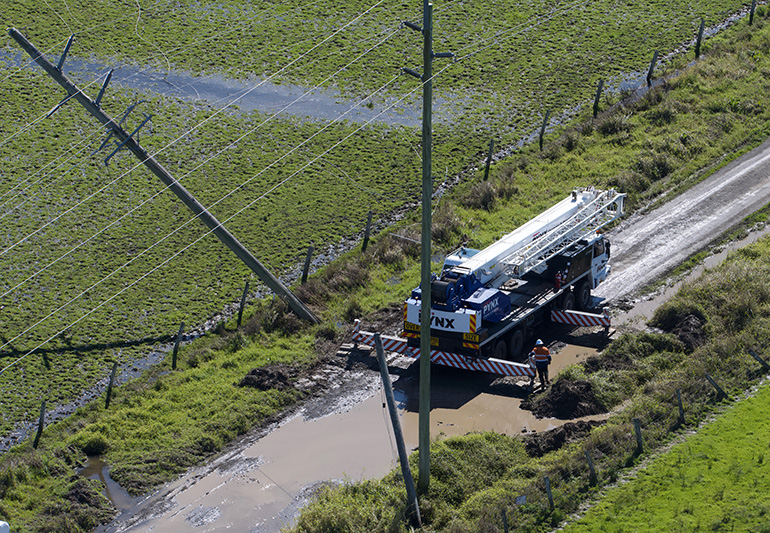
Essential Energy crews responding to the extensive storm damage on the Mid North Coast.


