
17 July 2025
Updated 31 March 2026
For more than a century, the Narromine farm has been at the heart of Karin Stark’s family, originally settled in 1897 by her father-in-law's grandparents, Karin is now leading the charge to transform this historic land into a beacon of sustainable innovation.
It was that ingrained innovation that came into action when Karin faced a daunting challenge. The farm's annual water pumping costs for their cotton crop had soared to $300,000 a year. Determined to find a solution, she recognised the potential in renewables to reduce costs and invested in a solar-diesel hybrid pump.
While the approach slashed their carbon emissions by 500 tonnes and saved $180,000 in diesel costs in the first year, Karin found the initial success of blending solar and diesel waned, proving it unreliable and unsustainable for their scale of farming operations.
"It was a great start, but we needed a more reliable solution,” Karin explains.
Karin had thought disconnecting completely from the electricity grid would meet her sustainability goals. When this approach couldn’t deliver the desired outcomes, Karin continued to explore options and began discussions with Essential Energy to see what was possible. She explored electrification, the process of replacing traditional diesel-powered generators with electricity powered systems and equipment.
Working with Essential Energy to model what was required to electrify her farm, Karin assessed the potential of shifting the fossil fuel power source for irrigation to the grid, supported by solar, and saw the potential for lower energy costs and emissions. It was estimated that the set up could lower operating costs by up to 50 per cent with potential savings resulting in a payback period on the initial investment being under five years.
"I was amazed at how much we could save just by exploring different options," Karin explains.
For Karin, the improvements go beyond the financial savings. Continuing the family legacy of the farm is deeply personal.
"Climate change for me personally and my partner, it was important to start looking at ways to decarbonise.”
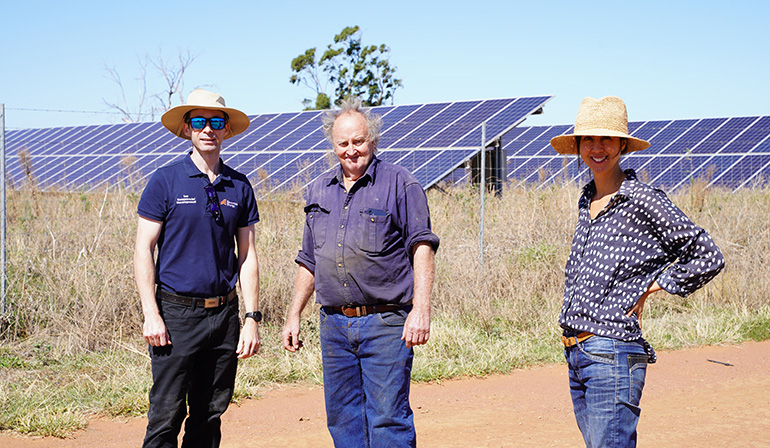
Ian Askell (Senior Commercial Specialist, Essential Energy), Ross Elder and Karin Stark
Electrifying traditional fossil fuel farming practices can reduce emissions by up to 50 per cent with the number being higher if it includes on-farm solar. And this is just the beginning; transitioning energy sources opens up future opportunities such as electric tractors, microgrids, and sharing power with neighbours.
"I definitely think the more people that do these types of projects and the more we can learn from each other, the better.”
Traditional farming practices rely on less efficient equipment that is reliant on costly fossil fuels which tend to have high maintenance needs. Electric pumps are cheaper, more reliable, and require less upkeep.
Electrifying agricultural practices not only promotes sustainability but can also improve safety. Electric machines are quieter and produce less vibration, creating safer, more comfortable working conditions.
There’s not a one-size-fits-all solution with electrification. That’s where Essential Energy’s specialist advisory team can help work with customers to assess the farming operation needs and suggest a range of alternatives and energy source combinations.
Essential Energy has a devoted team supporting farmers in regional, rural and remote New South Wales through their own energy transition. Our partnership with Karin is just one example of how the team is helping agricultural customers achieve their electrification goals for a sustainable and prosperous future.
For your free assessment, fill out our Electrification Specialist Form.
For more information about electrification, visit Electrification for Agricultural Operations.


