

As a holder of Environmental Protection Licences (EPL), Essential Energy is required to establish appropriate Pollution Incident Response Management Plans (PIRMP) under the Protection of the Environmental Operations Act 1997. Essential Energy has two PIRMPs, one is related to the transportation of waste oil and the other applies to storage of scheduled Polychlorinated biphenyls (PCB) within the Essential Energy network area.
Our trackable waste licence EPL 20973 covers certain situations where waste mineral oil that is unfit for its intended purpose will be transported in amounts over the regulated threshold of over 200 kg. The licence also covers the transportation of Environmentally Hazardous Chemicals, specifically PCB waste.
Essential Energy also holds licence EPL 21901 that permits scheduled PCB waste and scheduled PCB material to be stored (kept) at six specific sites across the Essential Energy footprint in a manner that reduces the risk of harm to human health and the environment. This includes waste oil and electrical apparatus items with concentration levels of 50 mg/kg PCB or more and exceeding 1,000kg that are not intended to be reused or recycled, as well as soil waste impacted by spills from these items meeting the same thresholds.
The relevant PIRMPs provide a planned approach to notify stakeholders and manage pollution incidents that could occur (albeit unlikely) as a result of these two activities. The following information outlines our PIRMP for notifying emergency services, regulatory authorities and the community following a pollution incident with a risk of material harm.
Notification protocols for emergency services and regulatory authorities
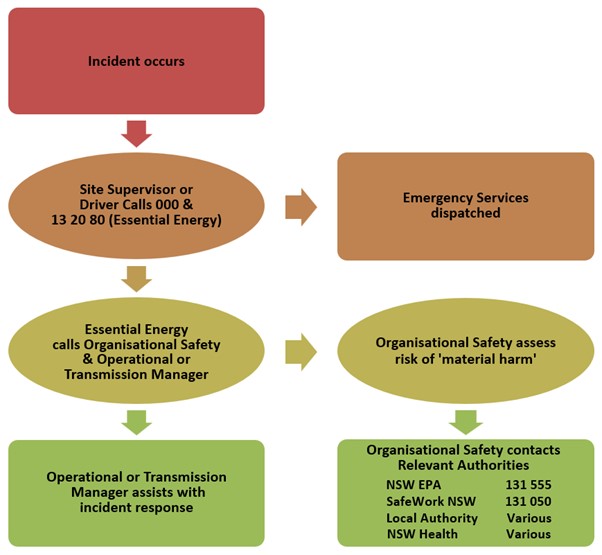
In the unlikely event of a pollution incident with a risk of material harm, where it is safe to do so our waste transportation vehicle driver or site supervisor of a PCB storage facility will take all reasonably practicable steps to contain pollution. Immediately after taking this action, the driver or site supervisor will contact emergency services and call us on 132080.
Once advised of the incident, we will contact staff members from our Organisational Safety team and our Operational or Transmission Services teams. These teams are responsible for notifying the relevant authorities and assisting with managing the incident response, while the incident is being physically addressed on the ground. If the driver or site supervisor is unable to contact us, they will liaise with the emergency services to notify the relevant local authorities.
The following diagram provides a summary of our PIRMP process for notifying emergency services and the relevant authorities following a pollution incident with a risk of material harm.
Contact details for emergency services and relevant regulatory authorities for reporting pollution incidents
| Service and authority contacts | Description | Contact details |
| Emergency services (Driver or Site Supervisor to contact via 000) | ||
| Fire and Rescue NSW | Fire and rescue services | 000 |
| NSW Police Force | Emergency and safety coordination | 000 |
| Ambulance Service of NSW | Medical emergency services | 000 |
| NSW State Emergency Service | Emergency and rescue services | 000 or 13 25 00 |
| Relevant authorities (Essential Energy to contact as required) |
||
| NSW Environment Protection Authority | Environment Line notification | 13 15 55 |
| SafeWork NSW | Dangerous incident notification | 13 10 50 |
| Local Council | Local Government Area notification | Various |
| NSW Ministry of Health | Contact call directs to the Local Public Health unit for notification | Various |
Notification protocols for members of the community
For a localised pollution event we will consult with the incident controller from emergency services (NSW Police Force or Fire and Rescue NSW) about what community notification, if any, should be undertaken.
If deemed necessary, we will notify the residents in the immediately affected vicinity of the pollution incident. If deemed necessary, we will also notify the wider community through relevant local councils or by other means appropriate to the circumstances and as determined by our Corporate Affairs team.


